

MRI appointment

Schedule an MRI appointment in Israel

Contact Us

Looking for an MRI appointment in Israel?

Medassist offers urgent MRI scan appointments at leading hospitals and diagnostic imaging centers in Tel Aviv, Jerusalem, Haifa, and the Northern District. In most cases, you can get your MRI on the same day or within 24–48 hours.

Quick MRI scan and Radiology Services

All Types of MRI Scans: Brain, spine, joints, abdomen, chest, and more…

Top Medical Facilities: We work with Israel’s most trusted hospitals and imaging institutions in Israel.

Fast Reporting: Experienced radiologists provide MRI results within 2 business days or in urgent cases, within just 6 hours.

בדיקת MRI, תורים מהירים MRI Appointment

Hassle-Free Experience: From booking your MRI to receiving results, Medassist ensures professional support every step of the way.

Document Translation Services: We provide fast and accurate translation of medical reports and documents (English / Hebrew) 

MRI Appointment & Document Assistance: We make the process seamless, helping with scheduling and international insurance handling.

Book your urgent Ultrasound test today and receive fast, accurate results with professional support every step of the way.

We’re Here to Help - Contact Us

Complete the request form or Contact our team by phone

What is an MRI Scan?

MRI (Magnetic Resonance Imaging) is an advanced medical imaging technique that allows doctors to obtain high-resolution images of organs and tissues inside the body without using ionizing radiation.

The MRI machine uses a powerful magnetic field and radio waves to scan the body, producing detailed images of internal organs, muscles, joints, brain, spine, blood vessels, and more.

Why Do You Need an MRI Scan?

MRI is used for accurate diagnosis of a wide range of medical conditions, including:

  • Unexplained pain in various parts of the body, head, back, or neck
  • Suspected herniated discs
  • Tumors or inflammatory processes
  • Sports injuries and trauma
  • Central nervous system disorders (e.g., multiple sclerosis)
  • Post-surgery or treatment follow-up

Each MRI scan is performed according to a precise medical protocol, tailored to the organ being examined and the clinical purpose.

How is an MRI Scan Performed?

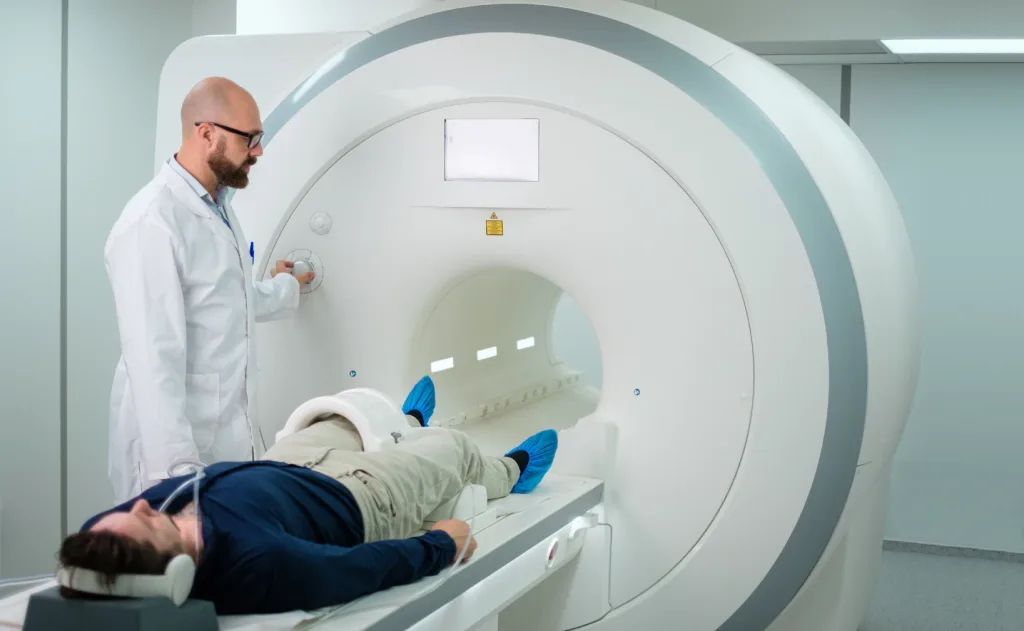
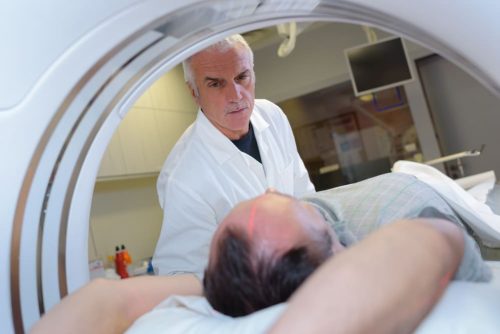
During an MRI, the patient lies on a motorized table that slides into a cylindrical imaging machine. Staying completely still during the scan is crucial for clear, sharp images. In some cases, a contrast agent (gadolinium) may be used to enhance specific areas of the body for better visualization.

Is an MRI Scan Safe?

MRI is considered a very safe diagnostic procedure because it does not use ionizing radiation, unlike X-rays or CT scans. The magnetic fields and radio waves used in MRI are non-invasive and generally well-tolerated by most patients.

However, there are certain situations where MRI may not be suitable. For example:

  • Individuals with pacemakers, defibrillators, or certain metal implants, which can be affected by strong magnetic fields
  • Pregnant women in the first trimester, unless the scan is medically necessary

To ensure patient safety, medical staff carefully screens each patient before the MRI scan. This includes asking detailed questions about medical history, implants, and any metal objects in the body. Patients are also instructed to remove jewelry, watches, and other metallic items before entering the MRI room.

For patients with pacemakers or metal implants, we assess whether an MRI-compatible device is present. If the MRI is not safe, we offer alternative imaging options, such as CT scans or ultrasound, to provide accurate diagnostic results without compromising safety.

We’re Here to Help - Contact Us

Complete the request form or Contact our team by phone

MRI test FAQs – a helpful questions and answers.

MRI (Magnetic Resonance Imaging) and CT (Computed Tomography) are both advanced medical imaging techniques, but they work differently and serve different diagnostic purposes.

CT scans use X-rays (ionizing radiation) to create detailed cross-sectional images of the body. They are performed quickly and are ideal for trauma cases, detecting fractures, urgent medical conditions, or rapid diagnosis in emergency situations.

MRI scans, on the other hand, use a strong magnetic field and radio waves—without any radiation—to produce extremely high-resolution images, especially of soft tissues like the brain, spine, muscles, tendons, ligaments, and joints.

No harmful radiation: MRI is safer, especially for children, pregnant women (depending on the trimester), and patients requiring repeated imaging.

Detailed imaging of soft tissues: MRI provides precise images of internal organs and delicate structures, including the central nervous system.

Detection of subtle issues: MRI can reveal problems that may not be visible on a CT scan.

In summary: MRI is preferred when detailed visualization of soft tissues is needed, or when avoiding radiation exposure is a priority.

MRI is not suitable for everyone. Special precautions are needed in certain cases:

  • Patients with pacemakers or certain metal implants
  • Pregnant women, particularly during the first trimester
  • Patients with external implants, which may need to be temporarily removed

It’s essential to inform the scheduling team and medical staff in advance. Some centers are equipped to safely remove and replace external implants before and after the scan.

Yes. An MRI requires a referral from a physician with a clear testing protocol. This ensures the MRI center performs the correct scan based on the organ, clinical purpose, and your medical condition.

Thanks to Medassist’s partnerships with private MRI centers and hospitals across Israel, we can find you a fast MRI appointment according to the required protocol.

Simply call us at 03-7724228 or complete the contact form with your contact details, and our representative will contact you promptly with available times.

In public hospitals, waiting times can reach several weeks.
With Medassist, appointments can often be scheduled within 24 hours or even on the same day, depending on availability, type of scan, and medical urgency.

MRI scans are performed according to a precise medical protocol based on the organ and clinical purpose. To schedule a scan, you need:

  • A referral from a specialist physician
  • Pre-scan screening, usually via a phone consultation, to ensure the patient can safely enter the MRI machine
  • Preparations, such as fasting, if contrast agents are required

We assist in handling of (international) insurance issues and we make sure the payment process goes smooth and with minimal bureaucratic hassle. In addition, we accept bank transfers, VISA, MasterCard and cash payment methods.

With valid insurance coverage, we can accept a Guaranty of Payment from your insurance provider and arrange your ultrasound appointment without upfront charges.

Read more about insurance coverage and  Guaranty Of Payment.

If you have the international health insurance – we will assist to handle the claim issues. In case you have not purchased international health insurance – only the method to cover the medical procedure or medical consultation is direct payment.

Yes, MRI scans through Medassist are private and paid services.. However, patients with insurance coverage may be eligible for full or partial reimbursement, depending on their policy.

If you are a foreign resident or have international insurance coverage, we can accept a Guaranty of Payment from your insurance company. This allows you to receive care without upfront payment, depending on your insurance policy.

For Israeli citizens with private health insurance, partial reimbursement may be available according to the terms of your insurance policy plan.

If you are a Foreign Resident and have International Health or Travel insurance, we can accept a Guaranty of Payment of your insurance company. This allows you to receive medical care without upfront payment, depending on your insurance policy. 

Read more how you can use your health or travel insurance in Israel by our partner Medex –  Medical Assistance

No, Medassist does not accept Form 17 (HMO Coverage) or public health fund coverage by Israeli Health Maintenance Organization (HMO) . All services are provided privately. Nevertheless, insured patients can seek reimbursement from their insurance company according to their policy terms.

If you are a foreign resident or have international insurance coverage, we can accept a Guaranty of Payment from your insurance company. This allows you to receive care without upfront payment, depending on your insurance policy.

ct scan, mri, petct, radiology

Most requested MRI exams

MRI בעמוד השדרה

Spine MRI

In which cases should a spine MRI examination be performed? The most common use is in cases of back pain, neck pain, disc herniation, spinal tumors, structural changes, and abnormal blood vessels. When the cause of pain is suspected to be a spinal tumor or infection or if the patient
Read more »
MRI אגן

Pelvic floor MRI

Pelvic floor MRI focuses on the pelvic floor and anus. It is used to assess anal muscle and sphincter structure and to diagnose the condition of the rectal wall. In which cases should a pelvic floor MRI examination be performed? Assessment of anal muscle and sphincter structure. Diagnosis of the
Read more »
MRI של דרכי המרה והלבלב MRCP

Biliary tract and pancreas MRI (MRCP)

Magnetic Resonance Cholangio-Pancreography An MRI examination for the diagnosis of biliary tract and pancreatic diseases is called MRCP – Magnetic Resonance Cholangio-Pancreography. It’s advantage lies in it being non-invasive (the examination is performed without catheter insertion, as opposed to an endoscopy examination) and usually does not include the injection of

Read more »
בדיקת MRI פרטי

Liver MRI

Liver MRI: Indications, Preparation, and What to Expect When is a Liver MRI Recommended? A liver MRI is a non-invasive imaging test used to diagnose liver diseases and monitor liver health. It is often performed to investigate findings from other imaging tests such as CT scans or ultrasounds. Common indications

Read more »
בדיקות-אולטרסאונד-לתינוקות

Fetal MRI

Fetal MRI is used as an addition to ultrasound-based safety measures during pregnancy monitoring. This examination is performed from the 14th week of pregnancy, but there are some diagnoses in fetal brain diagnosis that can only be performed from the 25th week of pregnancy. The examination is a tool that
Read more »
בדיקת בית החזה - MRI a heart-chest MRI examination

Heart – chest MRI

This examination diagnoses (Heart/Chest MRI)  cardiomyopathic morbidity – By using techniques, one can demonstrate myocardial movement, assess heart function and volume of heart chambers, measure blood flow, and characterize heart structure. In which cases should a heart-chest MRI examination be performed? Diagnosis of myocarditis. Location and severity of heart scarring

Read more »

Schedule your appointment today

Please provide your contact details